
All-Inclusive Addition
All-Inclusive permits include Building, Plumbing and Mechanical work. Any Electrical work will require a separate permit.
This handout is a compilation of some of the standard requirements based on the State Building Code and City Ordinance for projects of this type. This information packet does not contain all the specific codes for construction and should only be used as a guide. The permittee is responsible to meet all code requirements applicable to each project.
Note: If home is a Heritage Preservation Site (historic property), prior approval from the City Planner and/or HPC is required before issuance of permit.
Submittals
- Permit application- All-Inclusive Interior Finish/Addition
- Site survey/site plan-scaled drawing accurately showing the location of the proposed addition with distances from property lines, utility easements, power lines and other structures.
- Construction Plan(s):
-
- Foundation
- Floor Plan
- Wall Bracing Plan
- Header Plan
- Wall Section Worksheet
- Elevation Plan (lookout or walkout as applicable)
- Ledger Attachment (if applicable)
-
- Truss layout and details
- Heating details (how you plan to heat addition)
- Electrical permit application (if applicable)
- Owner-Contractor waiver if homeowner is completing the work themselves.
Required Inspections (as applicable)
- Footing (prior to placement of concrete)
- Foundation
- Plumbing underground
- Plumbing and mechanical rough-in, prior to concealing
- Electrical rough-in
- Sheathing (prior to weather resistive barrier installation)
- Framing (after all rough-in inspections have been approved)
- Insulation/vapor barrier
- Weather Resistive Barrier & Roof Underlayment (photos acceptable)
- Flood test (24 hr.) for tile shower base
- Plumbing and mechanical finals
- Electrical final
- Building final
General Requirements for Additions
- Additions must meet the Planning and Zoning Code and setback requirements. Zoning questions should be directed to the Planning Department: (651) 480-2381
- All work must be inspected prior to concealing.
- Additions must comply with the current Minnesota energy code including foundation insulation.
- Sleeping rooms must be at least 70 square feet in area, and not less than 7 feet in any horizontal dimension.
- Minimum ceiling height is 7 feet (R305)
- Sleeping rooms must have egress window (See Window handout).
- Smoke and carbon monoxide alarms will be verified throughout the home at final inspection. (See Smoke and Carbon alarm handout) (R314)
Residential Energy Code
- R402.1.1.4 Interior foundation insulation requirements.
- If a frame wall is installed, it shall not be in direct contact with the foundation wall.
- R402.2.8 Basement walls
- Walls associated with conditioned basements shall be insulated from the top of the basement wall down to 10 feet (3048 mm) below grade or to the top of the footing, whichever is less.
- R-15 insulation for concrete and masonry foundations shall be installed according to R402.l.l.1 to R402.l.l.8 and a minimum of a R-10 shall be installed on the exterior of the wall. Interior insulation, other than closed cell spray foam, shall not exceed R-11. Foundations shall be waterproofed in accordance with the applicable provisions of the International Residential Code (IRC).
- R402.1.1.7 Fiberglass batt interior insulation.
- Fiberglass batt insulation for foundation walls shall comply with the following:
- The above-grade exposed foundation wall height shall not exceed 1.5 feet (457 mm).
- Fiberglass insulation shall not exceed R-11
Fire-Resistant Construction
- Existing common walls/fire walls that are disturbed during construction require inspection before covering.
- R302.7 Under-stair protection.
- Enclosed space under stairs that is accessed by a door or access panel shall have walls, under-stair surface and any soffits protected on the enclosed side with 1/2-inch (12.7 mm) gypsum board.
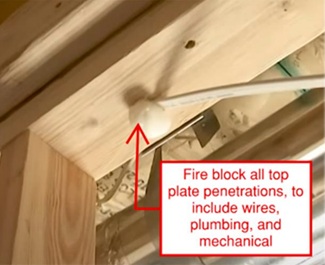
- R302.11 Fireblocking
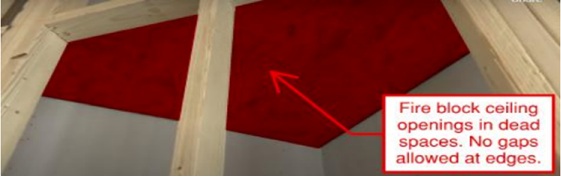
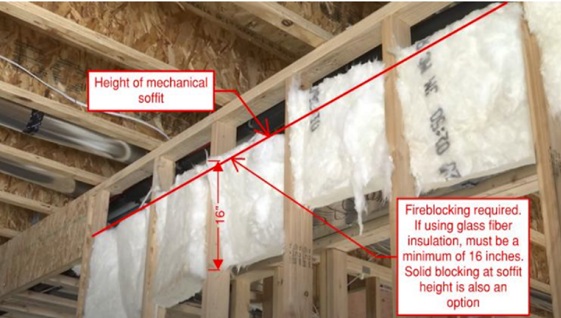
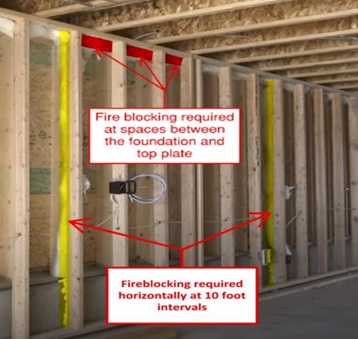
- In combustible construction, fireblocking shall be provided to cut off both vertical and horizontal concealed draft openings and to form an effective fire barrier between stories, and between a top story and the roof space.
- Fireblocking shall be provided in wood-framed construction in the following locations:
-
-
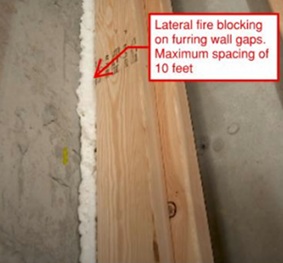
- In concealed spaces of stud walls and partitions, including furred spaces and parallel rows of studs or staggered studs, as follows:
- Vertically at the ceiling and floor levels.
- Horizontally at intervals not exceeding 10 feet (3048 mm).
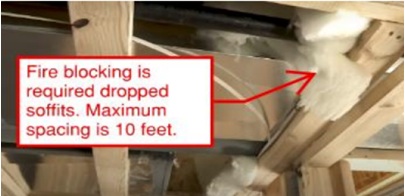
- At interconnections between concealed vertical and horizontal spaces such as occur at soffits, drop ceilings and cove ceilings.
- In concealed spaces between stair stringers at the top and bottom of the run. Enclosed spaces under stairs shall comply with Section R302.7.
- At openings around vents, pipes, ducts, cables and wires at ceiling and floor level, with an approved material to resist the free passage of flame and products of combustion. The material filling this annular space shall not be required to meet the ASTM E136 requirements.
- In concealed spaces of stud walls and partitions, including furred spaces and parallel rows of studs or staggered studs, as follows:
-
Plumbing Requirements
- Plumbing that is below the basement floor and has been moved, added to, or altered requires inspection before concealing.
- Showers shall have a 2” trap and drain.
- Cleanouts must remain accessible.
- Protect plumbing pipes with nail plates when within 1 ½” from the edge of the stud.
- Plumbing pipe shall be adequately supported; every 4 feet for PVC, ABS, and Copper, and every 32” for PEX.
- The maximum hot water temperature in bathtubs and whirlpool tubs shall be regulated by a limiting device conforming to either ASSE 1070/ASME A112.1070/CSA
- See Bathroom Finish Handout for additional information.
Mechanical Requirements
- All bathrooms must have an openable window, or artificial light and a mechanical vent to the outside.
- When enclosing mechanical rooms verify combustion air requirements.
- Exhaust ducts shall be insulated for a minimum of 3 feet inside the building envelope.
- All joints, seams, and connections in ducts shall be sealed with gaskets, mastics, liquid sealants, or tape.
- Building framing cavities shall not be used as ducts or plenums.
- Each habitable space/room shall be provided with a heat supply and return air.
- See Fireplace Handout with requirements for installing new fireplaces.
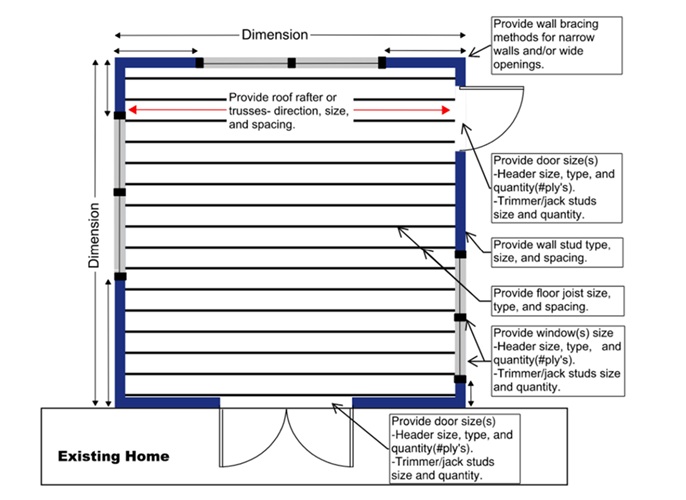
Floor Plan shall include the following
- Overall dimensions for the addition.
- All doors and window rough opening size and location.
- U-values from the manufacturer for each window & door.
- Header sizes, type, and quantity (e.g., 2-2”x10” Douglas Fir or 2-9 ½” LVLs)
- Beam sizes, type, and quantity.
- Wall stud, size, and type.
- Floor joists size, type, spacing, and orientation.
- Subfloor materials.
- Use for each room (e.g., Bathroom, Bedroom, Storage)
Building Safety
Phone: 651-480-2342
Sign up to our News and Notices
Stay up to date on the city's activities, events, programs and operations by subscribing to our news, notices and publications.